By Zajac Trial Group · Updated November 1, 2026 · Practical planning guide
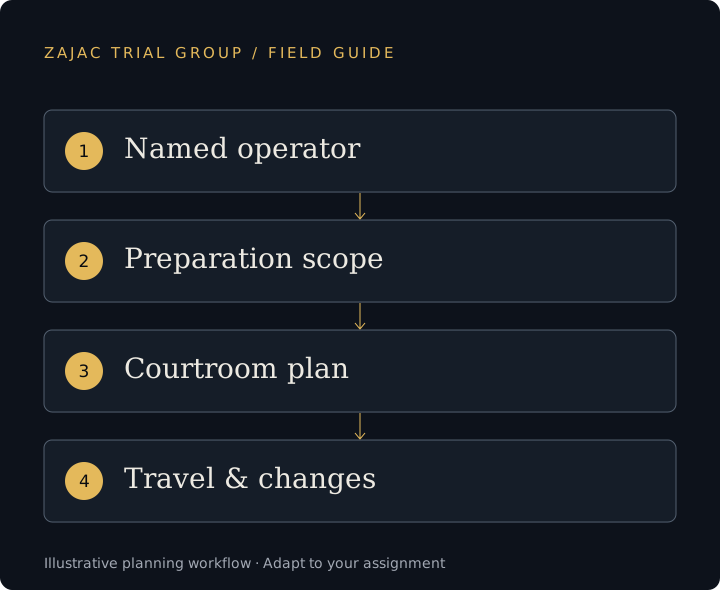
Describe the work you need.
Begin with the trial location, expected dates, estimated court days and the material to be presented. Identify documents, video testimony, audio, physical exhibits and graphics separately. A technician preparing a database from raw files has a different assignment from an operator receiving a checked presentation database.
State whether you need an in-person hot-seat operator, preparation assistance or both. If Jolie is your preferred specialist, request her by name and confirm her availability. A firm's availability and a particular operator's availability are different questions. For the service scope, see nationwide trial technician services.
Ask for a demonstration of the work.
A useful interview is specific. Ask the proposed operator to explain how they would find a changed exhibit number, recover from a missing video file and distinguish material ready for display from material awaiting counsel's approval. Use fictional or cleared samples for any demonstration.
- Who will prepare the database, and who will operate it in court?
- Which presentation platform and version will be used?
- How are revised files labeled and checked?
- What happens when a video designation changes the night before testimony?
- How will counsel signal “hold,” “publish” and “clear”?
- Which equipment and operator contingencies are actually included?
A software credential is useful supporting evidence. Ask about experience with the workflow your matter needs as well. Jolie holds the OnCue Advanced User Certification; our OnCue service page explains the scope.
See the retrieve, preview and publish sequence in our interactive exhibit demonstration. The exhibit and testimony are fictional.
Ask for comparable estimates.
Scroll sideways to view all columns
| Line item | Clarify before comparing |
|---|---|
| Preparation | Database build, transcript sync, clip editing, rehearsal and revisions. |
| Court attendance | Included hours, minimums, overtime and treatment of dark days. |
| Equipment | Laptops, software, adapters, displays, audio, installation and backup. |
| Travel | Travel time, airfare, lodging, ground transport and changes. |
| Schedule changes | Cancellation, continuance, extensions and reservation terms. |
A lower daily figure can cover fewer tasks. Ask each provider to identify included work and assumptions. Our trial technician cost guide provides a separate budgeting reference; historical examples are not a current Zajac Trial Group quote.
Plan the handoff and rehearsal.
Choose one person on the legal team to supply approved versions and resolve conflicting instructions. Before files move, agree on confidentiality terms, access and the transfer method. The initial availability inquiry only needs scheduling and scope information.
Build the schedule backward from the first planned examination: operator review, counsel corrections, final playback check and courtroom access. There is no universal number of days that makes every matter ready. A large exhibit set or unsynchronized testimony may need substantially more preparation than a short hearing.
The deliverable from the hiring conversation should be a written scope naming the operator, responsibilities, dates and assumptions. Use the preparation checklist to begin the next step.
Before we begin
Questions from trial teams.
Is a trial tech the same as a trial consultant?
The titles can overlap. A trial technician usually handles evidence preparation and presentation technology. Trial consulting may also include jury research or strategy. Ask exactly which work is included.
Can we hire a trial technician outside our home state?
Yes. Zajac Trial Group accepts assignments across the United States, subject to availability and agreed travel, setup and preparation arrangements.
Does the lowest hourly rate mean the lowest total cost?
Not necessarily. Compare the same preparation, attendance, equipment, travel and schedule-change assumptions before comparing totals.